
In 1839 Eduard Simon distilled an oily substance from storax, which is a resin of liqauidambar orientalis. Simon owned an apothecary, and business distracted him from his experiment. Several days later he noticed that the styrol had taken on a thicker form and he dubbed this new jelly styrol oxide. Unknowingly, he had created a substance that today takes the form of wall insulation, surfboards, molded coolers - even props used on Broadway and in Hollywood.
Six years later, an English chemist, John Blyth, and a German Chemist, August Wilhelm von Hofmann demonstrated that the process discovered by Simon could be recreated in the absence of oxygen. The duo dubbed their substance metastyrol. It would be 80 years before this everyday substance took a giant step forward.
Metastyrol's next stop was in 1866 when chemist Macrelin Berthelot realized that the process which the substance underwent was due to polymerization. Metastyrol had a new name: polystyrene. In the 1930's a German company, I.G. Farben, realized that this new substance could replace heavier, and more costly, die cast zinc. After manufacturing a reactor vessel, I.G. Farben was able to extract polystyrene through a long heated tube and cutter, which rendered it in pellet form.
Expanding Borders
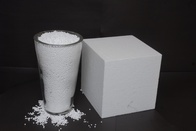
When polystyrene is exposed to a gaseous blowing agent, it expands into a foam, which is Expanded Polystyrene or EPS. Chances are, you use this product everyday - coffee cups, takeout containers, coolers - they're all made of EPS. The secret to EPS is the millions of voids of trapped air, these voids give EPS a low thermal conductivity - the hot stays hot and the cold stays cold.
Everyday EPS
EPS is strong and lightweight, making it an excellent construction material and insulator in paneling systems. Those packing peanuts that spilled out of your latest overnight package are EPS. Architects have used EPS for years as non-load bearing pillars in buildings, museums and homes. If you've ever watched a movie or gone to a play, many of the props and backgrounds were most likely constructed of EPS.
EPS for the Environment
In the past, some EPS contained CFCs, which were considered harmful to the environment and to human beings. Now, thanks to more environmentally friendly methods, EPS no longer contains CFCs. Another earth friendly feature is that EPS can be recycled.
Six years later, an English chemist, John Blyth, and a German Chemist, August Wilhelm von Hofmann demonstrated that the process discovered by Simon could be recreated in the absence of oxygen. The duo dubbed their substance metastyrol. It would be 80 years before this everyday substance took a giant step forward.
Metastyrol's next stop was in 1866 when chemist Macrelin Berthelot realized that the process which the substance underwent was due to polymerization. Metastyrol had a new name: polystyrene. In the 1930's a German company, I.G. Farben, realized that this new substance could replace heavier, and more costly, die cast zinc. After manufacturing a reactor vessel, I.G. Farben was able to extract polystyrene through a long heated tube and cutter, which rendered it in pellet form.
Expanding Borders
When polystyrene is exposed to a gaseous blowing agent, it expands into a foam, which is Expanded Polystyrene or EPS. Chances are, you use this product everyday - coffee cups, takeout containers, coolers - they're all made of EPS. The secret to EPS is the millions of voids of trapped air, these voids give EPS a low thermal conductivity - the hot stays hot and the cold stays cold.
Everyday EPS
EPS is strong and lightweight, making it an excellent construction material and insulator in paneling systems. Those packing peanuts that spilled out of your latest overnight package are EPS. Architects have used EPS for years as non-load bearing pillars in buildings, museums and homes. If you've ever watched a movie or gone to a play, many of the props and backgrounds were most likely constructed of EPS.
EPS for the Environment
In the past, some EPS contained CFCs, which were considered harmful to the environment and to human beings. Now, thanks to more environmentally friendly methods, EPS no longer contains CFCs. Another earth friendly feature is that EPS can be recycled.